The Problem: A Gap Between Two Studies
Two active MDOT studies address highway noise in Ann Arbor. Neither covers the northeast corridor where thousands of households live alongside M-14 and US-23.
| Study | Coverage Area | Chapel Hill Included? |
|---|---|---|
| M-14 Noise Analysis (PA 121 of 2024) | Newport Road to North Maple Road | No |
| US-23 Improvement Study | I-94 to Earhart Road (revised Nov. 2025) | No. Removed before noise analysis ran. |
| Gap Corridor (our neighborhoods) | M-14 from Pontiac Trail overpass east to US-23; US-23 south to Plymouth Road | Directly affected. Never studied. |
The US-23 Improvement Study approved six sound barriers within its corridor following a resident vote in summer 2025. Communities just north of the revised boundary received no equivalent analysis and no opportunity to vote.
The US-23 study's original northern boundary extended to the M-14/US-23 interchange, which would have placed our neighborhoods inside the study. That boundary was later revised south to the Earhart Road bridge, removing this corridor before any noise analysis was conducted. The revision was documented in MDOT technical materials published November 2025 but never communicated to affected residents. A Chapel Hill resident learned of it only during a March 23, 2026 conference call with Senator Shink, MDOT officials, and Ward 2 councilmembers.
Affected Communities
Thousands of households live alongside this corridor on both sides of US-23 north of the Earhart Road overpass, and along M-14 east of the Pontiac Trail overpass. None of the communities below received a noise analysis under either active MDOT study.
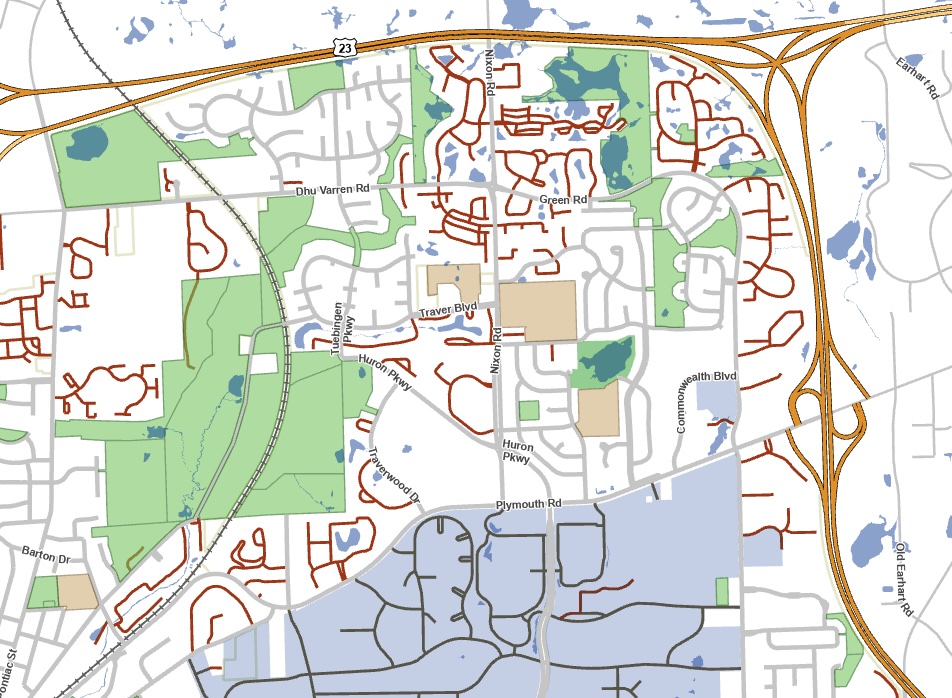
Total affected households across the corridor exceed 3,500 and continue to grow. The planned Village of Ann Arbor development alone will add 604 units directly adjacent to the corridor. The Ann Arbor 2025 Draft Comprehensive Plan designates significant density increases along Plymouth Road and the US-23 corridor, strengthening the long-term case for noise mitigation infrastructure.
Residents along this corridor experience elevated noise exposure from two converging highway segments with no natural or constructed mitigation.
Sleep & Cardiovascular Risk
The World Health Organization identifies traffic noise as a leading environmental health risk in Western Europe and North America.[1] Chronic sleep disturbance is the primary pathway to cardiovascular harm.
At 150 feet from a freeway at highway speed, noise levels are estimated at 70–75 dB, well above the federal residential impact threshold of 66 dB.
Cognitive Effects
Long-term exposure to ambient traffic noise above 55 dB(A) is associated with impaired memory and attention in both adults and children.[2]
Long-term exposure is also linked to higher rates of Alzheimer's disease, Parkinson's disease, and non-Alzheimer's dementia.
Air Quality
Near-highway air contains elevated levels of fine particle pollution (PM2.5 and PM10) from tire wear, brake dust, and road grit. These particles do not return to normal background levels until 300–500 meters from the road.
A solid noise barrier reduces near-road particle pollution by 40–80% behind the wall.[3] One structure, two major health benefits.
Property Value Impact
Residential properties within 300 meters of a major highway without noise barriers typically sell at a discount relative to equivalent properties further from the corridor.[4] Barrier installation has been shown to partially recover that discount in comparable markets.
Equity
Communities already addressed by MDOT studies and approved barriers are, on average, higher-income than the northeast corridor neighborhoods. The absence of organized advocacy here reflects a community that was never informed or consulted, not a community without impact.
[1] WHO Environmental Noise Guidelines for the European Region, 2018.
[2] Environmental Health Perspectives, "Road Traffic Noise and Cognitive Performance," 2022.
[3] Environmental Health, "Near-road air pollution and barrier mitigation," 2020.
[4] Journal of Environmental Economics and Management, highway proximity discount studies, 2015–2022.
How Highway Noise Studies Get Funded
Understanding why this corridor has never been studied requires knowing how MDOT noise programs work, and how federal funding actually gets approved once a study exists. There are three distinct pathways into a study, and one approval gate that sits underneath all of them.
Type 1: Tied to Road Construction
A Type 1 noise analysis is mandatory whenever MDOT builds or significantly alters a highway. Adding a lane, realigning a ramp, or substantially changing the vertical profile all trigger a required noise study for the affected corridor.
The US-23 Improvement Study is a documented Type 1 project. MDOT's own noise report confirms it was studied as Type 1 because the proposed build alternatives involved adding a weave-merge lane and making significant changes to the vertical alignment. Residents near that corridor received a noise analysis because MDOT was doing construction work there — not because MDOT proactively assessed which communities needed relief most.
The M-14 Noise Analysis is different in kind. It was not triggered by road construction at all. It exists solely because Senator Shink secured a $3 million legislative appropriation under PA 121 of 2024. Without that appropriation, no M-14 study would exist.
Type 2: The Voluntary Program for Existing Highways
A Type 2 project is the construction of noise barriers along an existing highway where no new construction is planned. This is the pathway that would normally apply to our corridor. Under Type 2, a community submits an application to MDOT, and if the noise impact and barrier feasibility criteria are met, federal-aid funds can be used for construction.
However, MDOT's Type 2 program is currently suspended due to budget constraints. Applications are not being accepted. The standard community pathway to noise barriers is closed. There is no active queue, no timeline for reinstatement, and no indication of when funding will be restored.
The PA 121 Model: A Third Path
The M-14 study represents a third path: a direct legislative appropriation that bypasses both Type 1 and Type 2 entirely. Senator Shink secured $3 million under PA 121 of 2024 specifically to fund a standalone noise study where no construction project existed to trigger Type 1, and the Type 2 program was unavailable.
MDOT had previously refused a City of Ann Arbor request to address M-14 noise, stating in 2022 that it did not normally engage in noise abatement outside of standard program structures. PA 121 changed that by creating a funding source independent of either program.
This legislative appropriation model is exactly what we are asking the Legislature to replicate for the northeast corridor. A dedicated appropriation would fund both the noise study and barrier construction without waiting for a construction project that may never come, or a Type 2 program that is currently closed. It has been done once for Ann Arbor. We are asking for it to be done again for the neighborhoods that were left out.
The TIP Vote: Where Federal Dollars Actually Get Committed
None of the three paths above releases federal money by itself. Before a noise study or barrier project, however it gets triggered, can spend federal highway funds, it has to be placed on the Transportation Improvement Program (TIP) and approved by a formal vote of the WATS Policy Committee. WATS, the Washtenaw Area Transportation Study, is the federally designated planning organization for the county. Its Policy Committee includes representatives from the County Board, the Road Commission, TheRide, the University of Michigan, MDOT itself, and the cities and townships along the corridor, and that committee's vote is what actually authorizes a project to draw federal dollars.
This is the layer our asks have mostly skipped so far. A legislative appropriation gets a study funded. It does not, by itself, commit federal construction money, that still runs through the TIP vote. The same WATS Policy Committee discussed the original US-23 study's scope and alternatives in 2024, the same year the Trains Not Lanes campaign got the project's widening alternatives eliminated, partly by engaging this committee directly rather than relying on public comment alone. Their account of that campaign is the closest precedent we have for what actually moves this process. Mike Davis Jr., MDOT's University Region Planner for this corridor (517-750-0401), sits on the WATS Policy Committee himself, and is the MDOT staff contact this campaign is working through directly rather than asking the public to contact on our behalf.
Source: MDOT Highway Noise Analysis and Abatement Policy. Type 1 and Type 2 definitions are codified under 23 CFR 772 and State Transportation Commission Noise Abatement Policy #10136. The Type 2 suspension notice appears on the MDOT Noise Abatement program page. The US-23 Type 1 classification is documented in the US-23 Ann Arbor Noise Report (November 2025). TIP and Policy Committee structure documented on the WATS Transportation Improvement Program page.
Our asks
- Institutional record: Formal resolutions of support from the City of Ann Arbor, Ann Arbor Township, and Washtenaw County, naming this corridor and requesting MDOT/WATS action. This is the documented record MDOT and WATS actually respond to.
- WATS / TIP: That the WATS Policy Committee place a northeast corridor noise study on the Transportation Improvement Program, the vote that actually authorizes federal funding, not just a study sitting on a wish list.
- Legislative appropriation: A dedicated appropriation for a noise study and barrier construction, modeled on PA 121 of 2024, as the funding source if the TIP/WATS route stalls.
- MDOT scope: That MDOT include this corridor in the active M-14 study, or in any future US-23/M-14 interchange study, which agency staff have indicated is anticipated given the interchange's outdated geometry and known merge issues.
Our goal is equitable mitigation, not criticism of past processes. We are asking for the same consideration already extended to other communities alongside these same highways.
Senator Sue Shink, who secured the PA 121 appropriation for the M-14 study, has cited the 1,000-signature Wines Elementary petition as the model that prompted MDOT to act. Demonstrated community support remains the most direct path to legislative attention, and petition signatures are part of that record.
But MDOT and WATS do not run on petitions. The residents who got this same project's original widening plans eliminated in 2024 built their case primarily through institutional resolutions and direct engagement with MDOT's regional staff and the WATS Policy Committee, not public comment alone. Their account of that campaign is worth reading before assuming the petition does the heavy lifting on its own.
Sign the petition and share it with your neighbors. It strengthens the record. It is not the whole strategy.
Frequently Asked Questions
Why can't we just plant trees or vegetation instead of building walls?
Vegetation and earthen berms provide only minimal noise reduction (1–3 dB) and take many years to grow. Solid noise barriers can reduce noise by 5–15 dB, which is clearly noticeable and meets federal standards. MDOT and FHWA guidelines confirm that dense vegetation alone does not qualify as effective abatement for most residential areas.
How much do noise barriers cost and who pays?
Typical costs range from $1–3 million per mile depending on height, length, and terrain. For this corridor, a legislative appropriation (like the $3M already secured for the M-14 study via PA 121) is the most realistic path. Federal funds can cover a large portion when paired with state or local match.
What is the difference between Type 1 and Type 2 projects?
Type 1 is required when MDOT does major construction (new lanes, ramps, etc.). Type 2 is for adding barriers to existing highways with no new construction. Unfortunately, MDOT’s Type 2 program is currently suspended due to budget constraints.
What is the WATS TIP vote, and why does it matter more than the petition?
WATS (the Washtenaw Area Transportation Study) is the federally designated transportation planning body for the county. Before any project, however it gets funded, can spend federal highway dollars, it has to be placed on WATS's Transportation Improvement Program through a formal vote of its Policy Committee. A petition builds political pressure and can help secure a legislative appropriation, but it does not cast that vote. Getting this corridor into a study that actually gets built runs through institutional engagement with MDOT and WATS, not the petition alone.
Will this raise my taxes?
No. The requested legislative appropriation uses state transportation funds (often federal matching dollars). It does not require new local property taxes. Successful projects in Troy and elsewhere followed this model without increasing resident taxes.
When could barriers actually be built?
If the Legislature funds a study this year, design and construction could begin within 2–4 years, similar to the timeline for other recent MDOT noise projects in Ann Arbor.
Official References and Background Materials
All claims in this briefing are grounded in publicly available MDOT project documentation, state legislation, and peer-reviewed research.
-
Download
NE A2 Barriers — Community Overview (.docx, 17 KB) Full community briefing covering the study gap, affected neighborhoods, health impacts, and legislative ask. Suitable for sharing with neighbors, HOA boards, and elected officials.
-
MDOT Policy
MDOT Noise Abatement Program (Type 1 & Type 2) Official MDOT policy page defining Type 1 and Type 2 noise projects. Confirms the Type 2 voluntary program is currently suspended due to budget constraints. Applications are not being accepted.
-
MDOT
M-14 Ann Arbor Noise Analysis (PA 121 of 2024) Official MDOT study page. Coverage: Newport Road to North Maple Road. Funded by the Michigan Legislature, $3M appropriation.
-
MDOT
US-23 Ann Arbor Noise Report (November 2025) Official MDOT noise analysis report. Confirms the US-23 study was conducted as a Type 1 project triggered by planned construction. Documents the six approved noise barriers and the boundary at Earhart Road.
-
MDOT
US-23 Improvement Study, Ann Arbor Official MDOT study page. Northern boundary revised to just north of Earhart Road (November 2025). Six sound barriers approved for communities within the study corridor following a summer 2025 resident vote.
-
MDOT Press Release
MDOT Kicks Off M-14 Noise Study in Ann Arbor (January 30, 2026) Official announcement of the M-14 noise study commencement. Confirms legislative mandate and study scope.
-
Legislation
Michigan Public Act 121 of 2024 The appropriations act that funded the M-14 noise study. Relevant language at page 363 of the enrolled bill.
-
City of Ann Arbor
Ann Arbor 2025 Draft Comprehensive Plan Draft plan designates density increases along Plymouth Road and the US-23 corridor. Strengthens the long-term rationale for noise mitigation infrastructure along the gap corridor.
-
WATS / MPO
WATS Transportation Improvement Program (TIP) Official WATS page. The TIP is the near-term list of projects approved to receive federal funding. Placement requires a formal vote of the WATS Policy Committee, whose members include the County Board, Road Commission, TheRide, the University of Michigan, and MDOT.
-
City of Ann Arbor
Resolution R-23-386 (October 16, 2023) Ann Arbor Council resolution opposing added lanes and calling for continuous walking/biking connections across US-23. Precedent for the institutional resolutions this campaign is now seeking.
-
City of Ann Arbor
Resolution R-24-091 (March 18, 2024) Ann Arbor Council resolution supporting TheRide's transit alternative for the US-23 corridor. A second example of council resolution language used as direct leverage with MDOT on this same project.
-
Background
Streetsblog: How Ann Arbor Advocates Got a Highway Expansion Cancelled (2024) Account of the Trains Not Lanes campaign, which eliminated the original I-94-to-M-14 widening alternatives on this same corridor through institutional resolutions and direct WATS/MDOT engagement. The closest precedent for our funding strategy.
-
Background
Bridge Michigan: Troy Residents Get $10M State Sound Walls Context on how comparable communities secured legislative appropriations for sound barrier construction through resident petition and elected-official advocacy.
Contact Your Representatives
Direct constituent communication matters. If you live in the affected corridor, your message carries weight. Send a brief note identifying yourself as a constituent and asking for support on sound barrier funding.
Share This Page
Help spread the word by sharing this page with neighbors in the corridor.
Questions about this effort? This is a resident-initiated advocacy campaign, not an HOA communication. Contact: nea2barriers@gmail.com
Add Your Name
The petition takes 30 seconds. Every signature from the corridor strengthens the case for a legislative appropriation.
Sign the Petition on Change.org →